
01
Clean water
Clean water
Algae take up nitrogen and phosphorus from the water and clean it. The system is designed to recover most of the nitrogen as algal protein rather than releasing it to the air.
Green Economy, with Microalgae.
Effluent from factories and fish farms, or rivers, lakes and coasts with too many nutrients: microalgae take up the nitrogen, phosphorus and CO₂, clean the water, and turn them into biomass for feed and fertilizer. Bloomo, our AI-controlled cultivation system, makes it work.
Vision & Mission
Vision
We use algae to link two jobs into one loop: cleaning water and producing food. Algae take up CO₂, and take up nitrogen directly as ammonia, so in principle they skip the bacterial steps that release nitrogen oxides (NOx, N₂O). The goal is an economy where protecting the environment is also what makes a business profitable.
Mission
Microalgae × AI for water and food.
The nitrogen, phosphorus and CO₂ in wastewater, rivers, lakes and the sea are food for algae. We use AI and IoT to keep algae working reliably, so treatment plants, farms and waterside sites can run it every day.
1 → 2 Cleaning water3 → 4 Producing food→ 2 Takes up CO₂, releases no NOx or N₂O
For Novel Generation.Handing the next generation a safe planet and a living ocean.
* In bacterial nitrification and denitrification, NO and N₂O form along the way and part escapes to the air (Kampschreur et al., Water Res 43: 4093–4103, 2009). Microalgae assimilate ammonia directly into amino acids and skip these steps.
Value Proposition
Treatment, biomass and CO₂ uptake at the same time. Algae feed on the nutrients already in the water, so the growth medium costs next to nothing (harvesting and drying have their own costs).
Clean water
Algae take up nitrogen and phosphorus from the water and clean it. The system is designed to recover most of the nitrogen as algal protein rather than releasing it to the air.
Biomass
The algae become raw material for aquaculture feed and agricultural fertilizer. Water you used to pay to treat now yields something you can use.
Carbon
Algae take up CO₂ through photosynthesis and turn it into biomass. We assess the greenhouse-gas benefit by LCA, comparing against the materials replaced and including long-term storage such as biochar.
IoT lets us watch operation remotely and AI adjusts it, reducing the work on site. Rather than selling equipment and walking away, we keep delivering treatment and feedstock outcomes.
Key Technical Differentiators
Three technologies work together to treat nutrient-laden water without stopping and turn it into biomass.
Algal Bloom Capture
Under the right conditions microalgae multiply very quickly (an algal bloom). Ocean phytoplankton are estimated to photosynthesise on a scale comparable to land plants*. Bloomo puts this vigorous growth to work with selected, non-toxic strains, under control inside a closed system.
Algal Bloom Capture (ABC) in detail →Selective breeding
We keep a library built by non-GMO selective breeding and choose the strain that suits the water on site.
The strain library in detail →IoT + MLOps
IoT watches the culture and MLOps (continuously updating control models with operating data) is designed to keep high-density culture running steadily.
IoT sensing and AI culture control in detail →* Land and ocean are estimated to contribute roughly equally to global net primary production (Field et al., Science 281: 237–240, 1998); much of it returns to the air through respiration within a short time.
Conventional treatmentNitrification and denitrification release most of the nitrogen to the air as N₂ gas, and part of it as N₂O, a potent greenhouse gas
BloomoMost of the nitrogen is recovered as algal protein and put to use as feed or fertilizer (the full nitrogen balance is being verified in demonstration)
Customer Benefits
The equipment, the strains and Bloomo Cloud are the same everywhere. What changes is the water that goes in and where the output goes.
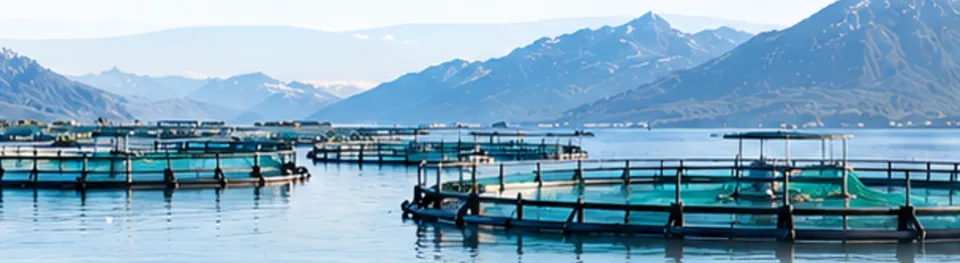 AquacultureDemonstration
In:Farm waterBloomoOut:Live feed / feed・Clean water
Stronger production at lower cost
Your challenge
Feed and live-feed costs, losses in hot summers, farm effluent
What you get
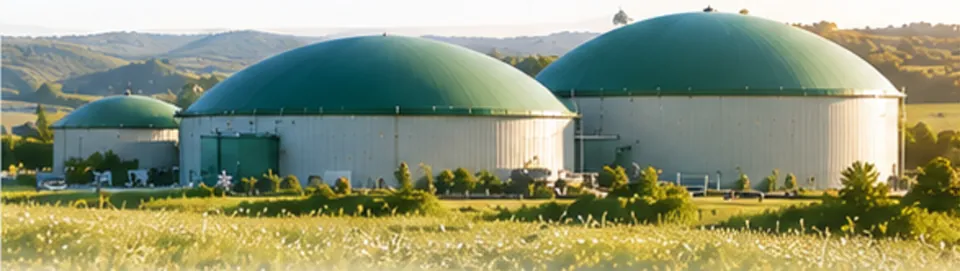 BiogasR&D
In:Digestate・CO₂BloomoOut:Fertilizer・Treated water
Turning digestate treatment into resources
Your challenge
Nitrogen-rich digestate, the cost of nitrification and denitrification, CO₂ from gas upgrading
What you get
 Industrial effluentR&D
In:Effluent・Waste heat・CO₂BloomoOut:Algae as raw material・Treated water
Lower treatment costs, new raw material
Your challenge
High-strength effluent, carbon regulation, unused waste heat and flue gas
What you get
 Municipal wastewaterR&D
In:N- and P-rich waterBloomoOut:Clean water・Fertilizer / biochar
Cleaner water, fewer emissions
Your challenge
Power for aeration, nitrogen and phosphorus limits, N₂O and lost resources
What you get
 Rivers, lakes and coastsR&D
In:Nutrient-rich waterBloomoOut:Clean water・Fertilizer
Recovering the nutrients behind algal blooms and red tides
Your challenge
Harmful algal blooms and red tides in nutrient-rich waters, declining water quality
What you get
Note: Bloomo is in demonstration in aquaculture. Municipal, industrial, biogas and natural-water applications are in R&D; the points above are the goals we are working on now.
Products
One approach, offered at the size you need.
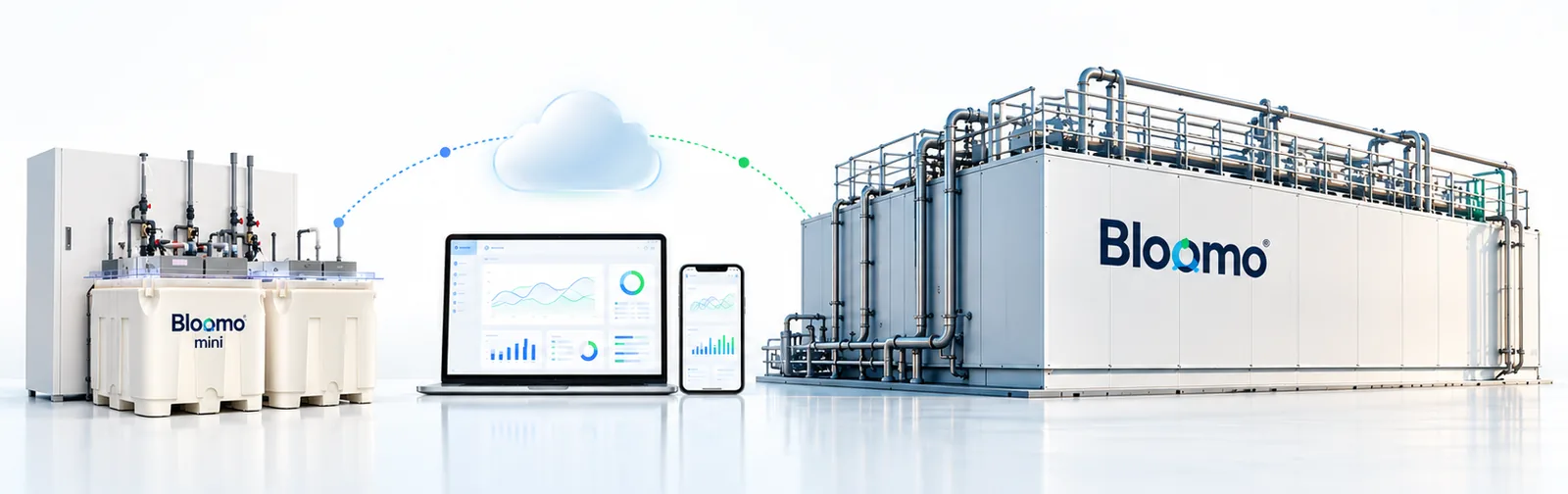
Modular units that retrofit to existing facilities, so you can start small.
Remote monitoring and control of every unit; operating data improves control site by site.
Plant-scale continuous culture, to be offered after large-scale demonstration.
Safety & Compliance
The principles we hold to, so municipalities and companies can evaluate us with confidence.
Whether algae go to feed or fertilizer depends on the source water and on analyses (heavy metals, pathogens and more). Algae grown on municipal sewage go to non-feed uses such as fertilizer and biochar. Feed and fertilizer uses are checked against the applicable laws.
We culture and harvest non-GMO strains confirmed not to produce toxins, inside the unit.
We analyse treated water against discharge standards and the conditions of the receiving water, and harvest the algae so they do not remain in it.
Figures on this site carry labels such as “literature value” or “theoretical value”. Our own demonstration data is shared individually under NDA.
Before a PoC we agree in contract on objectives and success metrics, duration, cost sharing, and how operating data and IP are handled.
How to start
With the flow, the water quality and how you treat it today, we can suggest where to begin.
FAQ
Novelgen is a startup founded in 2019 in Nagahama, Shiga, Japan. We use microalgae and AI to turn the nutrients (nitrogen and phosphorus) and CO₂ in water into resources such as feed and fertilizer.
Bloomo is a system for continuous microalgae culture. IoT monitors the culture and AI adjusts operation. It works together with Bloomo Cloud, our remote monitoring service.
Bloomo is in demonstration in aquaculture today. Applications in municipal wastewater, industrial effluent, biogas, and nutrient-rich rivers, lakes and coasts are in R&D.
No. We choose non-GMO selected strains that suit the water on site and have been confirmed not to produce toxins.
We go step by step: site survey, strain selection and testing, a small and short PoC, then full deployment. Start by choosing “Deployment or pilot (PoC) inquiry” on our contact form.
Our track record as an R&D startup, backed by third-party evidence
SBIR Phase 3 subsidy cap (MAFF, through Mar 2028)
Competitive Grants Awarded
IP assets (internal count)
Awards & Certifications
Note: this is the subsidy cap of MAFF’s SME Innovation Promotion Program (SBIR Phase 3 fund) as published by the Nagahama Institute of Bio-Science and Technology (through March 2028). It is non-repayable, non-dilutive public R&D funding, not equity raised. Counts are internal (as of November 2026); the main awards and grants are listed on the Media & Awards page.
Theoretical CO₂ taken up by photosynthesis per tonne of algal biomass (dry weight), assuming 50% carbon; not a net reduction
Net reductions will be assessed by LCA (ISO 14040/14044) including power, CO₂ supply, harvesting and drying. The literature behind our figures is published on the evidence page.
View the Evidence PageAn R&D startup using science to protect the planet
Novelgen Co., Ltd. was founded in 2019 in Nagahama, Shiga, Japan. Using microalgae and AI, we develop Algal Bloom Capture, a technology that turns the nutrients and CO₂ in water into resources such as feed and fertilizer, and Bloomo, our cultivation system. Our head office is in Nagahama, Shiga, with a base in Tokyo. For our vision and mission, see “Vision & Mission” near the top of this page.
2019
Founded
Shiga & Tokyo
Locations
22
Team Size
12
IP Assets
A team of specialists working on global problems

Ph.D. Specializing in genetic engineering, microbial microalgae science, and genome evolution. Founded Novelgen to put research to work in society. Also serves as a university professor. Faculty of Agriculture, Graduate School of Agricultural and Life Sciences, SOKENDAI.
LinkedIn
Chief Strategy Officer. Responsible for intellectual property at food, pharmaceutical, and chemical manufacturers, and business strategy at a consulting firm. A patent attorney who formulates business strategies based on IP portfolio development. Graduate School of Agriculture, Tohoku University; Univ. of Washington, School of Law LL.M.
LinkedIn
Chief Development Officer. Responsible for establishing process development methodology and mass production technology at a chemical manufacturer. Overseeing product development management. Graduate School of Science and Engineering, Waseda University.
LinkedIn
Chief Marketing Officer. Expanded the oyster distribution business at Japan's largest domestic oyster processing manufacturer and opened Japan's first oyster export business to the EU. Appointed as a Ministry of Agriculture, Forestry and Fisheries GFP Partner.
For Investors & Partners
How the business is progressing, our approach to R&D and IP, and our funding: the information you need is gathered on our investor page.
Oct 22, 2026
Oct 1, 2026
Sep 25, 2026
Aug 17, 2026
Jul 23, 2026
Jun 19, 2026
Jun 10, 2026
Jun 10, 2026
Jun 10, 2026
May 27, 2026
May 27, 2026
May 25, 2026